Wallops Industry Day Highlights NASA’s Growing Economic Impact On Eastern Shore
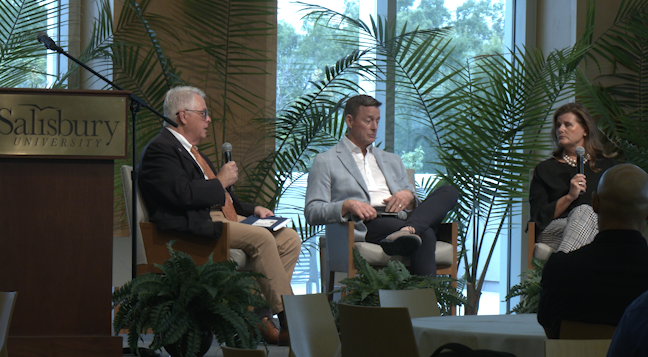
SALISBURY, Md. — Wednesday marked Wallops Flight Facility Industry Day, an event highlighting NASA’s economic impact on Maryland’s Eastern Shore.
The Maryland Economic Development Corp. hosted the third annual Wallops Industry Day at Salisbury University, bringing together companies including Firefly Aerospace, Rocket Lab and Northrop Grumman, along with representatives from Salisbury University, Wor-Wic Community College and the University of Maryland Eastern Shore.
David Pierce, director of NASA’s Wallops Flight Facility, said building connections with the community is an important part of Wallops’ mission.
“It’s important to build those connections with the community because Wallops is about the community,” Pierce said.
Whether it is flying airplanes, supporting the Ocean City Air Show or launching rockets, Pierce said Wallops is inspiring students on the Eastern Shore to pursue careers in the industry.
“It captures the imagination of our people. It inspires our young people to take up careers in STEM and science and engineering, and these are great-paying jobs,” Pierce said. “You don’t have to be a rocket scientist to work at Wallops. It takes all kinds of career backgrounds to work there, and now we’re going to the moon.”
That mission is expected to bring changes to Wallops in the near future.
“NASA Wallops is now becoming part of the Kennedy Space Center. With that, we are going to increase the number of launches from Wallops as we go back to the moon to stay,” Pierce said. “This is going to require us developing that next generation of scientists and engineers who are going to come and work at Wallops.”
Pierce said the agency is focused on working with academic and corporate partners to build the next generation of the aerospace workforce.
“It’s an exciting future for us as we work with our partners and academia and our corporate partners and launch to build that next generation of workforce, which is what we need, and we want to attract them here,” he said.
Keeping workers on the Eastern Shore
Keeping workers and businesses on the Eastern Shore was another focus of the event.
Wicomico County Executive Julie Giordano said partnerships with NASA could help create more opportunities and keep people working in the region.
“If we can build all those partnerships together and they see us working with the Eastern Shore of Virginia, you know, and then all the way up to Wicomico County and even beyond that, it’ll create more opportunity for people here,” Giordano said.
She added that NASA is a significant job creator for Wicomico County.
“It is creating job opportunities. But again, I know I’ve said this numerous times, I just feel like we can do a better job really pushing the fact that it is right here,” Giordano said. “We have so many things here on the Shore that I think the western side of the bridge sort of forgets what we have here.”
Wallops Island Flight Facility has been located on Virginia’s Eastern Shore since 1945, but the majority of NASA’s employees are from Maryland’s Eastern Shore.
Tom Sadowski, CEO of MEDCO, said Maryland’s partnership and support of Wallops helps drive innovation and exploration.
“This really impacts our quality of life and our national security in a lot of ways, so it is, I think, incumbent upon us not just to focus on the immediate economic development interest but really start to think about the impacts on humankind,” Sadowski said.
Sadowski said Maryland has a long history in the aerospace industry and that he wants to see that history continue to grow.
“I’d like to see that sustained and grown over time,” he said another goal is keeping employees on the shore. “80% of the growth comes from your existing employment base. So, we appreciate the work that they do here.”
Preparing for future launches
Pierce said partnerships between NASA, Virginia, Maryland and private companies are important in fueling innovation and exploration.
“Together, we have fueled over $300 million in investment that’s now fueling both the state of Virginia and Maryland, as well as our corporate partners to invest,” Pierce said.
He said the investment is helping build launchpad and payload-processing capabilities needed to support future missions.
“Together, we’re building the capability of launchpads, but also the other capabilities of payload processing that we need to be able to host these payloads that are going to go into space in low-Earth orbit,” Pierce said.
Pierce said Wallops will focus on small- to medium-sized launch vehicles, while Kennedy Space Center will focus on heavy-lift vehicles into deep space operated by companies such as SpaceX and Blue Origin.
“Together, we’re going to support going to the moon and then on to Mars,” he said.
Scott Bissett, deputy program director for Kratos Defense for the MACH-TB 2.0 program up, said the pace of innovation at Wallops is increasing.
“The cadence over the last year has certainly increased with the MACH TB 2.0 program. We’re really ramping up, onboarding. We will have nearly 2 dozen missions on the books by the end of this year, with the goal of launching at least half of those missions from Wallops,” Bissett said.
He said increased testing opportunities at Wallops could benefit both national defense and scientific research.
“A lot of times, they tie hand in hand. What’s good for defense is good for science. What’s good for science is good for defense,” Bissett said.
He said the program is working to accelerate hypersonic testing by conducting more launches and relying less on modeling and simulation.
“We’ve sort of fallen behind on the hypersonic side. So we’re really trying to accelerate, again, the actual testing that we’re doing, not relying on modeling and simulation, but actually launching things, putting them out there in space and seeing how they act,” Bissett said.
Coleman McCord, director of launch site development for Firefly Aerospace, said Wallops provides capabilities that are valuable to commercial companies and national defense.
“Wallops unlocks a lot of capabilities. You have the regulatory framework here. You have the fact that NASA has already been operating the site for decades and doing both orbital and suborbital missions, doing a ton of test activity,” McCord said.
“For us as a commercial company, it really unlocks new capabilities. And it’s going to kind of increase the importance for national defense from capabilities that we already had to have out of Cape Canaveral,” he said.