Local advocate and grandmother self-publishes book on grief, healing through community
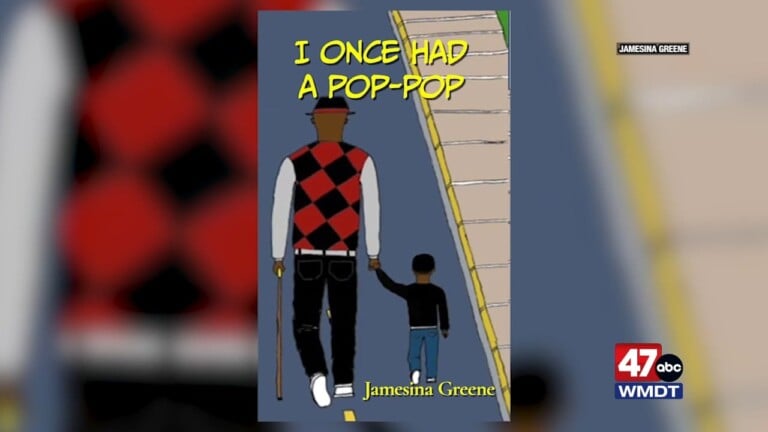
Salisbury, Md. – Despite recovering from her fifth spinal surgery and moving, Salisbury-resident and founder of A Mother’s Cry, Jamesina Greene sat down with WMDT’s Andrea Durán to discuss grief, legacy and community through her book, “I Once Had A Pop-Pop.”
Published in January, “I Once Had A Pop-Pop” follows the story of young boys as they come to terms with their grandfather’s passing. While a work of fiction, Greene says the book is inspired by events in her own life.
AD: In addition to being a mother and grandmother, you are also the mother of a son who is currently incarcerated. You founded A Mother’s Cry, an advocacy and support network for mothers whose children are currently incarcerated. How has your advocacy shaped your writing?
JG: When my son went away, my youngest son was only 12 years old. His response to his brother being sentenced… sent to prison, and given that ridiculous amount of time, had a great impact on him.
He went from being really quiet to being very angry. Started having disciplinary problems in school. And it all stemmed from the fact that his brother… because his father was not in his life, his brother was…more than just a big brother to him.
I have spoken with mothers who, at the beginning of the journey of having an incarcerated child, they do seem to be consumed with the incarcerated child, and they don’t pay much attention to those that are not incarcerated.
When I come across situations like that, I remind them that your children are suffering as much as you are, just in a different way. And they may not know how to verbalize to you the pain that they’re feeling, but we have to pay attention to that.
So, this book … yes, it was written as a response to the grief of losing my dad and losing their Pop-Pop, but it helped me also when I’m dealing with mothers who have incarcerated children that still have other children, to remind them to let that child grieve.
AD: It sounds like this book is almost autobiographical. How did real-life events inspire you to write this book?
JG: My parents died three months and three days apart. So, it’s quite a challenging time. But, right after my father died, my 5- and 6-year-old grandsons, along with my 7-year-old nephew, were talking to each other. And they were saying… “the adults won’t let us talk about Pop-Pop. And we miss Pop-Pop, too, and we love Pop-Pop, too. … because every time I say something about Pop-Pop, my mom, like, hugs me and starts talking about something else.”
So I stood there for a few minutes, and I listened to them share their feelings, and then I explained to them that, “sometimes adults do that because we think we’re protecting you.
We don’t want you to be sad, we don’t want you to hurt. But what I’m realizing as I’m listening to you guys is that you need a way to express your grief also. It may be different than ours, but you should be able to talk about your relationship with Pop-Pop, and the fact that you’re gonna miss him as well.”
So I asked each of them to tell me, “If they had had an opportunity to spend a day with Pop-Pop, one-on-one, what are some of the things that they would like to have done with Pop-Pop?”
Each one gave me a list of things that they wished they had done with their Pop-Pop, and I took those wishes and turned them into a book.
AD: Every chapter is a different child’s wish of a final day they’d spend with your father, their “Pop-Pop.” How did you go into writing that and bringing that to life?
JG: The interesting thing for me, Andrea, is that I didn’t just throw this in and say, “oh, he went to an NFL game with his Pop-Pop.” I researched each idea.
One of the children — my dad was a bailiff — so, one of them said they would like to go to a court to sit in the courtroom and see what that’s like, so we did that.
And then… near the end of the book, the Pop-Pop takes all seven of the boys to St. Augustine, Florida, on vacation. St. Augustine, Florida, is where my father was actually born.
He had promised my sisters and me he would take us, but we never got there. So, I had him take the boys there on vacation. I literally researched tourist attractions in the area for the kids and everything.
And so there’s a chapter in there where they each share their special day with Pop-Pop, how much it meant to them, how he loved them. And [he] spent time with them, and gave each one of them a special gift.
AD: What was it like processing your own grief through writing this book? How long did it take to finish it, let alone publish it?
JG: It took me years to finish it, to be honest, because it just brought back so many emotions for me, because I’m the definition of a daddy’s girl. So, to relive these events, it really took me a while to get the book finished.
AD: What would you like people to understand about your book?
JG: What I want people to understand is that it’s not… it’s categorized on Amazon as a children’s book. But it’s much more than a children’s book. It’s a legacy book.
It shows the bond between children and their grandparents, and what’s left even after that person is physically gone: that bond is still there.
AD: What does legacy mean to you? Especially as it relates to loved ones?
JG: Every day we are creating a legacy. And what is left for our loved ones? It’s gonna be up to us.
When you’re gone, from this realm, and people think of you, what will they think? Right? I just want us to understand that we are making an impact. On our children, our grandchildren, the youth in our community. We’re making an impact, whether we realize it or not. And I just think we need to pay more attention to the impact that we are making.
AD: It’s interesting that you also brought up not just the immediate circle of loved ones and children, but also the community, right? It’s interesting how grief can really pull people together when done in a certain way. And are you hoping that your book helps establish more community with people, even outside their families?
JG: Absolutely, because I’ve said this for many, many years, grief is a powerful bonding agent, right? A lot of people bond through grief experiences.
For example, I know mothers whose children have died to gun violence. And they meet other mothers whose children have died to gun violence, and now they’re bonded. I meet mothers whose sons or daughters have committed suicide, and they connect with other mothers whose children have committed suicide, and now they’re bonded.
It is a community thing. It’s not just about my faith, right? It’s not just about my relations, personal, intimate relationships. But it’s about our community. And that’s what I’ve been trying to do when I was doing a better job of talking about the book, I reached out to churches and other nonprofits and organizations, and I said, “look, I think, not just because I wrote it, but because I know the heart of the book. I think this is a great tool for our community, especially with all the craziness that we see going on in our community every week.”
There’s a story on your news channel or online about something that’s happened to one of our youth that is not positive. We need to talk about that, and we need to offer them something that says, “I can have feelings, and they don’t have to turn violent. I can grieve the loss of someone.”
So, I think the community part is extremely important, Andrea, because when we lose someone, it’s not just… it doesn’t just impact us. That’s not even reality, right? There’s somebody that knows you, that knows that person, that is impacted as well. So, community is extremely important.
AD: Correct me if I’m wrong, but it sounds like you’re trying to combat gun violence with community, and that’s through just being open about the grief that is impacting the community in all sorts of ways. Are you hoping that by giving people, especially youth, more outlets for these huge feelings, they can not only learn about community but also play an active role in it?
JG: There’s so many mental health agencies and so many things that are being cut. And the bottom line is, all we have is community that we can really depend on, right?
We don’t need government permission to get together with the young people in our community and say, “hey, I know you’re going through something, let’s talk about it.”
We have got to, as a community, acknowledge grief. Stop pretending that it doesn’t exist. Stop telling people to just get over it.
Acknowledge it, and then we have to come together and find positive ways to process that as a group.
And I think the way I’ve structured “I Once Had A Pop-Pop” shows that, you know, the boys could acknowledge that they missed their Pop-Pop. They could acknowledge that there’s gonna be a void there.
But they also had good memories.
AD: Are you hoping that “Once I Had A Pop-Pop” provides a tool for families to discuss their own losses, as well as trying to be able to have real conversations about things that are impacting their emotional and mental well-being?
JG: Absolutely, absolutely. I want it to be a tool that the family can read together, that they can discuss together, and that they can get input from each person.
“How did that make you feel? What did you think about that?”And then, “what can I do to leave something for you, not necessarily a tangible thing, but what can I leave for you to always let you know that you are loved?”
One of the lines in the book that the Pop-Pop says to the boys while they’re on vacation is that “even when I am no longer here with you physically, my love remains.”
“I Once Had A Pop-Pop” is available on Amazon as a paperback or as an ebook.
This interview has been edited slightly and condensed for clarity.