Connection, community and culture at Native American Festival
Vienna, Md. – The beat of a drum reverberated throughout the festival, consistently keeping time like a heartbeat.
“It’s the heartbeat of us and listening to it, it’s therapeutic and anybody in the audience that can hear it, it speaks to their soul,” Dennis Zotigh of the Zotigh Singers said. Zotigh is a writer and cultural specialist at the National Museum of the American Indian and a member of the Kiowa Gourd Clan and San Juan Pueblo Winter Clan.
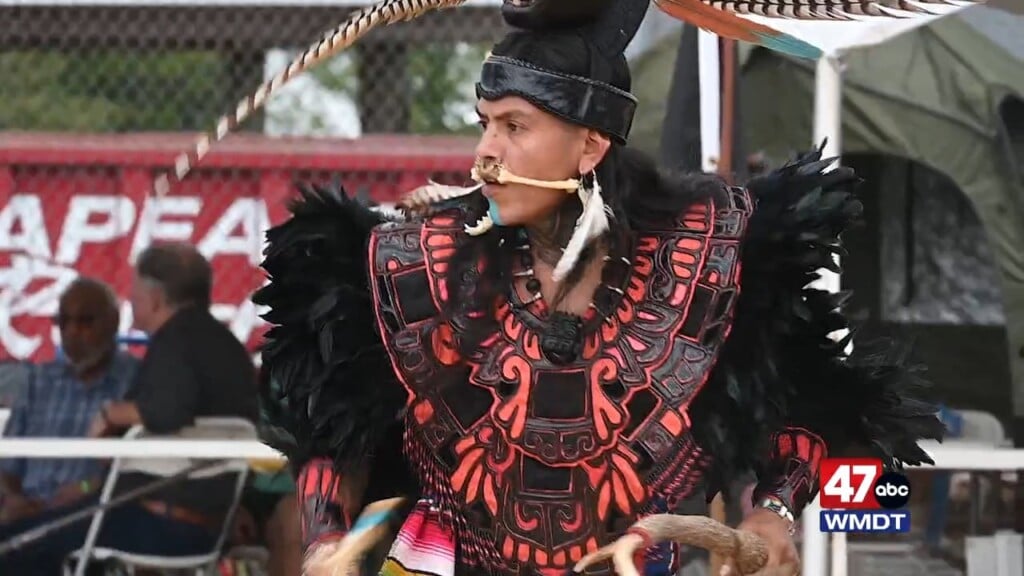
On Saturday, connection took center stage at the Native American Festival hosted by the Nause-Waiwash Band of Indians. Roughly 1,000 attendees came from 10 a.m. to 5 p.m. to learn more about Native cultures from all over the Americas through art, dance or even simple conversation.
“It’s good when we can come together for a family activity. Children and grandparents can come together and dance to a common drumbeat. And if the whole world could do that, this would be a different world,” Zotigh said.
Nause-Waiwash Chief Donna “Wolf Mother” Abbott said the festival was the tribe’s biggest event of the year because it’s also the tribe’s biggest fundraiser.
“Any of the profits that we get from this, we put into renovating two of our buildings, which both of them are churches,” she said. “And we donate to other organizations, charities in the area. We like our education, so those that educate usually are the first ones that we try to support.”
Education is paramount to Abbott’s mission to share appreciation for Native cultures, and she said she was glad so many came to learn about the rich diversity of different clans, tribes and nations.
“Native communities are one big community. We do support one another,” Nause-Waiwash Chief Donna “Wolf Mother” Abbott said. “And when you get down to it, we’re all after the same thing. We’re all about preserving our history and preserving the culture and educating people.”
The event was also a means to raise awareness for tens of thousands of missing and murdered Indigenous people across the country.
Jennifer Larsen of the Crow Tribe wore red regalia and a red handprint on her face to show support for murdered and missing indigenous peoples, saying, in her culture, red is meant to call out to their spirits.
“This is a joyous time, but it’s also a time to bring awareness to the situation,” Larsen said. “The more we stand as a community, hopefully we’ll get this to stop.”
Danny Osorio is descended from the Mexica people, also known as Aztecs. He said positive change is achieved through connection. After his dance, he invited all attendees, whether or not they are Native, to dance in the dance arena.
“Nosotros deberíamos de invitarlos — no importa de qué tribu seas o que no seas de tribu. ¿Por qué? Porque el Creador nos ha demostrado que el sol sale pa’ todos,” Osorio said. “We ought to invite them, it doesn’t matter from what tribe you’re from or if you don’t belong to a tribe at all. Why? Because the Creator has shown us the sun rises for everyone.”
For Washington College senior Terrance Vincent, who recently learned he has indigenous heritage, said he jumped at the chance to learn more about Native cultures through a school trip to the festival.
“One of my biggest takeaways from today is just caring about other people. So they care about me. And then by proxy, the land that I’m on and the things that I eat and everything that I do,” Vincent said.
Kayl Rainer is originally from New Mexico and sang in the drum circle and danced at Saturday’s festival, representing his San Carlos Apache and Duchesne heritage. He also has previously interned for Rep. Teresa Leger Fernández (D-NM Congressional District 3) on Capitol Hill.
“Finding a native community really means all the difference. Because I’ve been in D.C. without a native community,” he said. “[But] with a native community, you know, I feel at home.”
Abbott and Rainer both said that the best way to support and uplift Native voices is to engage.
“Come out, educate yourself. Come support native people, support Native creators, Native artists,” Rainer said. “It’s, you know, it’s a beautiful culture we have. I wish more people knew about it.”