Don’t Chuck Your Shucks
SUSSEX COUNTY, Del. – The Delaware Center for Inland Bays has been protecting the oyster population on the shore since 2014 through their “Don’t Chuck your Shucks” Program.
Through the program, the Inland Bays partners with restaurants from Lewes, Bethany Beach and Fenwick Island. Jack Gazda, a shellfish project specialist for the inland bays will collect any shells that are used on plates and repurpose those shells in the bays to grow new oysters.
He explained it’s a five step process, “First the slurp, then the collection, then the prep, then the repurpose, and then the benefit.”
The Slurp – Customers visit restaurants to enjoy the oysters.
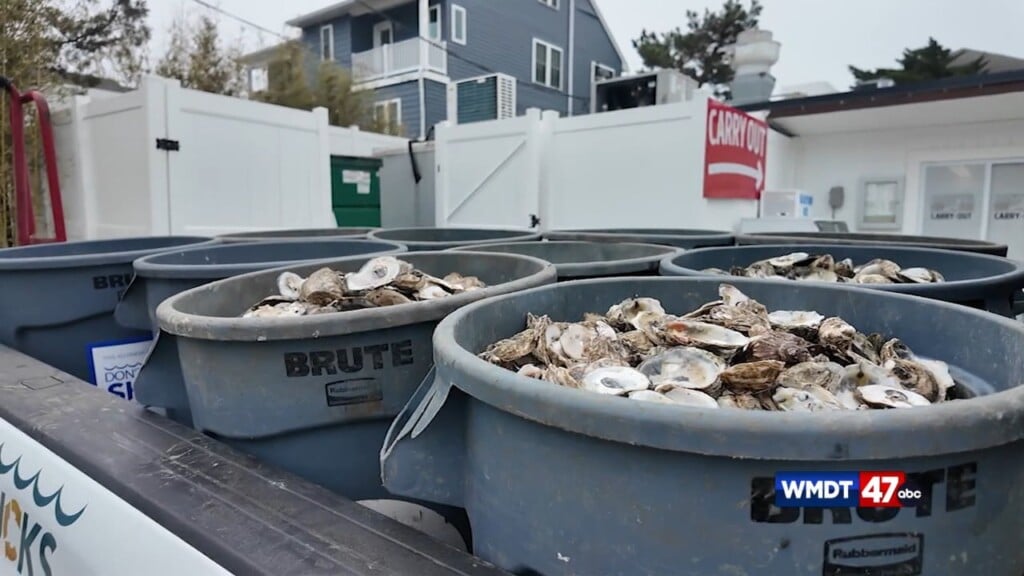
The Collection – Gazda travels to their 26 partnered restaurants to collect 32 gallon cans that contain used shells. Restaurants including:
- Above The Dunes
- Bear Trap Dunes
- Big Oyster Brewery
- Bluecoast (Bethany)
- Bluecoast (Rehoboth)
- Catch 54
- Chesapeake & Maine
- Drift
- Fins Ale House (Bethany)
- Fins Ale House (Rehoboth)
- Fins Ale House (Selbyville)
- Fins Fish House
- Fish On
- Henlopen City Oyster House Hooked Up
- JR’s Seafoord Shack
- Lewes Oyster House
- Lobster Shanty
- Matt’s Fish Camp (Lewes)
- Matt’s Fish Camp (Bethany)
- Matt’s Fish Camp (Fenwick)
- Starboard RAW
- The Blue Crab
- The Clubhouse at Baywood
- Wheelhouse
- Zoggs
The Prep – The shells get dropped off in a shell yard to age for six months.
“Between the rain, the snow, the bugs, the birds, they’ll feed off any remaining bio matter that’s left on the shells. Clean them up, sanitize in a natural way, and then we’re able to then use them as part of a project.” Gazda explained.
The Repurpose – Once the shells are done aging, they will be picked up again by dump trucks, and be distributed throughout three reefs.
Gazda said the non profit had created three of the largest living reefs in the history of the three inland bays. He added:
“In the fall of 2014, we used 15 14-wheel dump truck loads full of shell, just bulk shell. A local contractor donated their time and equipment to cart the shells from here over to a staging area, in Ocean View by the Marina, and then we had partnered with professional contractors who had an airboat with a hopper, took them out to Pasture Point, where the shells were. Then dumped over the creation of the three different structures.”
The different structures that Gazda mentions are six by six pressure treated cinderblock boards, concrete, tide attenuation piers, and shell burritos. He explained for the shell burritos, volunteers help put together the equivalent of a garbage can full of shells, rolled it up like a burrito in mesh, and tie it off. Around 60 of those burritos were used as a border in 2024.
The Benefit – Seeing the program work by seeing the oyster population succeed. Since the program has started, Gazda told me around 3.3 million pounds of shells have been saved from being thrown into landfills.
One of their growing areas at Pasture Point is in their second growing season. The wild oyster population was almost completely wiped out by mid-last century, but since this program has started, the Inland Bays has seen an increase in wild and farmed oyster populations. Communications Specialist, Clare Magargal told me their goal at Pasture Point is to have a self-sustaining population of oysters. She said last year they had about 50-80 oysters per square meter of reef. Their first milestone will be when they reach 100 oysters per square meter.
Gazda said they are the only non profit in the inland bays that deals with research, restoration, and education.
“We’ve got the James Ecological Farm, which is, a phenomenal hiking trail as well as sand beach. There’s also a massive variety of educational programs that the educational team puts on for school age children and even adults,” Gazda said. “Now that we have our newly blessed, Ball center, the education center has actually a roof that they can go under if the weather is bad.”
The Delaware Center of Inland Bays also reached a milestone of planting 43,000 trees. They’re always looking for volunteers. To sign up to volunteer or attend any of their events, visit the inland bays’ website.