Environmental experts work to restore salt marsh in Maryland coastal bays
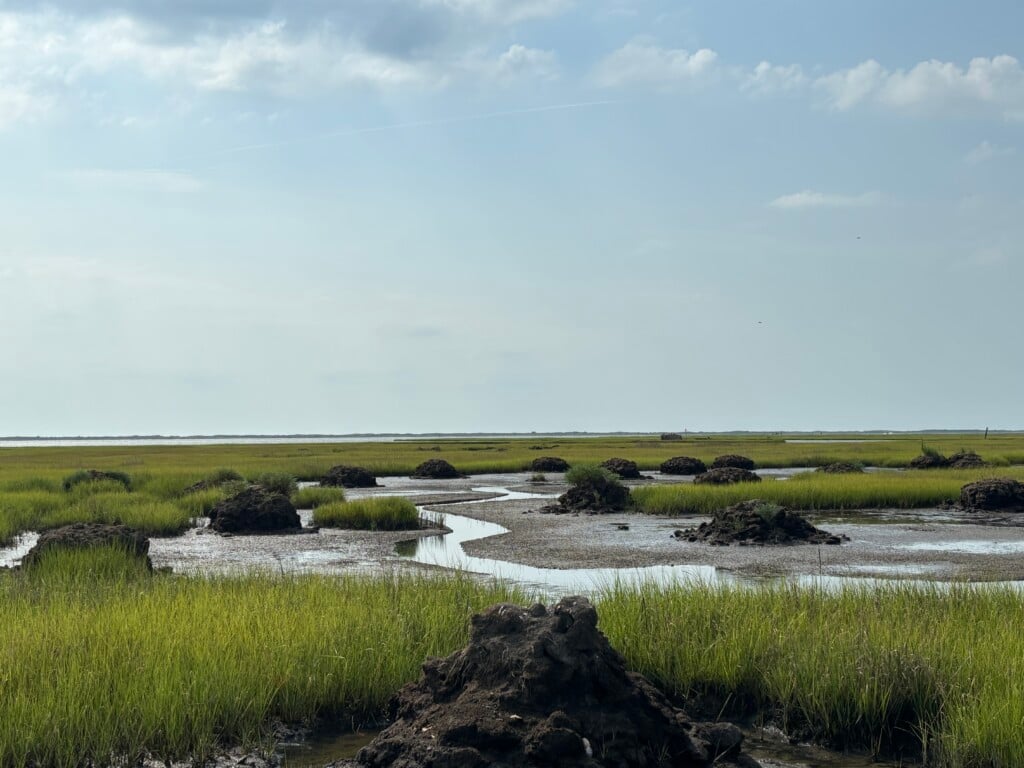
Berlin, Md. – The wind whips the smell of sulfur through the air while heavy boots squelch through the muddy grounds of the salt marshlands near Berlin, Maryland. However, Sophia Blanco Seufert and Liz Wist cannot stop smiling as they trudge through the marsh. They shriek with glee when they come across tentative pale green shoots of aquatic grasses.
Seufert is a biologist with the U.S. Fish and Wildlife Service and Wist is an education coordinator with the Maryland Coastal Bays Program. The U.S. Fish and Wildlife Service, with support from the Maryland Costal Bays Program and Delmarva Resource Conservation and Development Council, is in the process of restoring over 1,000 acres of salt marsh across Worcester County. Earlier this year, the Delmarva Restoration and Conservation Network received funds from the Chesapeake WILD program for its “Marshes for Tomorrow” project. Though the restoration sites on Worcester County do not receive funds from Chesapeake WILD, the overall Marshes for Tomorrow project does. Seufert’s efforts to restore and conserve the salt marsh in the Maryland Coastal Bay is part of the project to restore Delmarva’s marshes.

U.S. Fish and Wildlife Service Biologist Sophia Seufert surveying a salt marsh in Worcester County.
According to the National Oceanic and Atmospheric Administration, salt marshes like the ones found on Maryland’s Coastal Bays have the potential to sequester up to ten times the amount of carbon than rain forests.
“In our conservation work, we’re really lucky to benefit from both federal and state funds,” Seufert said. “We have programs like the Chesapeake WILD program, the National Coastal Resilience Fund and the State of Maryland Trust Fund that really support a lot of this conservation work.”
As she and Wist walk along the marsh, they take note of bird prints in the mud.
“There’s a lot of species that are super iconic to Maryland, like the blue crab, horseshoe crabs, diamondback terrapins, herons, egrets that are really quintessential Maryland species that rely heavily on salt marshes for both their breeding, foraging, and just their day to day habitat,” Seufert said.
She also said most people don’t realize how beneficial marshlands are for people as well as wildlife.
“They offer a lot of protection for our coastal properties and infrastructure from storms and high wave energy,” she said. “They also are really important breeding grounds for our commercial fisheries. Species such as blue crab and striped bass.”
Seufert said one of the reasons why the USFWS is heavily interested on salt marshes at the moment is because they are disappearing at a rapid rate.
“There’s a lot of historical alteration done to our marshes in the early 20th century, where they were ditched for mosquito control,” she said. “At the time, they didn’t realize what kind of impact that would have on the ecosystem. But now we’re facing the effects of that, along with the looming threats of sea level rise and the fact that Maryland is actually sinking due to where we are in geological time. So when we design these restoration projects, we’re really thinking about all of those challenges and trying to help the site adapt to them.”
Seufert says that because of the pace of salt marsh loss, they are working with a lot of partners across the Eastern Shore of Maryland including Audubon, Mid-Atlantic and the Maryland Coastal Bays Program.
“And we have all come together to prioritize the most important areas to conserve marsh across the whole Eastern Shore,” she said. “And through that process, we were also able to loop in the community and get feedback on which areas were selected so that we can be a lot more strategic about our conservation of this resource into the future.” Both Seufert and Wist said that they also work with indigenous peoples across Delmarva to gain invaluable feedback, insight and knowledge.
According to Seufert, another key component to their work is partnering with local landowners because so much of the marsh in the area is privately owned. Through their marsh restoration projects, the USFWS is restoring healthy hydrology to the marsh and enhancing the elevation to allow native grasses to grow back and provide nesting habitats for local marsh bird species. Hydrology is the study of water movement, distribution, and properties on, above and below the surface, including an ecosystem’s water cycle and water resources.

Bird egg in marsh grasses. Courtesy of Sophia Blanco Seufert of the U.S. Fish and Wildlife Service.
“Sometimes we say this phrase, ‘wildlife doesn’t stop at the land ownership boundaries,'” she said. She added conservation work is not limited to “parks or reserves.”
A lot of Maryland marshes have these pooled areas where water gets trapped and then is not able to escape the marsh, Seufert said.
“If you think about your garden, no plant wants to be underwater all the time, even our marshes,” she said. “And so if we’re able to work within the site to drain that impounded water off, then we allow vegetation to recolonize. At this site, we’re going to be monitoring over the next several years to watch that process happen. ”
As for Wist, she works with local schools to raise awareness for conservation and get students involved.
“We feel really privileged that we’ve had the opportunity to design two different programs, alongside of community and partners in order to deepen and develop everybody’s connection and awareness to the coastal bay’s salt marshes a little bit further,” she said.
The first program the Maryland Coastal Bays Program is currently working on is “lovingly” called “Marsh Grasses in the Classes,” where the Program works with five different classrooms part of Worcester County Public Schools. Wist says classrooms have greenhouses they have built themselves on their school grounds. The effort is to raise some of the grasses found on salt marshes.
“And what they’re going to do with that is they’re going to come out on field trips in the spring to restoration sites and get that real world experience of planting right here in their own watershed in their hometown,” she said.
The second program, Wist says, is for anyone in the community. She said the Maryland Coastal Bay Program will host events like a film screening at Assateague National Seashore on salt marsh sparrows well as a “Go Fish Worcester” event where anyone with any experience can come out fishing. “Rods and everything will be provided,” she said.
She said an important component to the conservation effort is to connection, both with the land and the community.
“I think that the root of it all comes down to the connection that we have to this place, and any opportunity we can provide to deepen that sense of place and help people feel connected, on various levels is just going to be essential,” she said.
For Seufert and Wist, connection is a main drive for their work.
“The barrier island systems, the marshes, the waterways, our forests, our farmlands, all of it,” Wist said. “All of it’s important for different reasons. And all of us are connected to it for different reasons.”

Liz Wist of the Maryland Maryland Coastal Bays Program (left) and Sophia Blanco Seufert of the U.S. Fish and Wildlife Service (right). (Andrea Durán/WMDT)