Live Green: Foraging at Meadowlands Retreat
PRINCESS ANNE, Md – Using the resources around you to find your own food can be easier than you think.
Owner of Meadowlands Retreat and foraging expert, Amanda Elyse has been teaching herself how to forage for 12 years. She started the retreat after attending a Tracker school which was started by a man named, Tom Brown.
“He learned from one of the native men whose named Grandfather. So Grandfather would go around and learn from different tribes, different healing tools and modalities of existing, and then he taught Tom Brown,” Amanda explained. “So, he opened up some protected land, or he got a contract with some protected land up in the Pine Barrens in New Jersey, and so that’s where he started this camp. He had to drive like 45 minutes into the woods. They like tote you in. He just recently passed away, and so then the Pine Barrens all of a sudden had a fire, and they hadn’t had a fire in like, forever. Most of the camp just burned down, which is like so symbolic.”
She started Meadowlands, continuing Tom Brown’s mission to encourage people to reconnect with nature.
“The whole idea is remembering your human nature and so whatever that means to us is like what we offer there. So, it could be foraging, one thing I like to do is primitive skills classes there, meditation, forest meditation, learning to make your own medicine, sourdough classes, all ancestral skills possible.”
There are a variety of plants across the Eastern Shore that people can forage for. During the winter, it’s usually a time to hunt because plants die off, but roots can still be edible, such as the dandelion.
“Seasonally, the root is going to be where most of the mineral components are right now. The root is going to be like where all the medicinal benefits are to extract the most benefit from it,” Amanda said. “When the dandelion dies back in the spring, after it has bloomed and everything, it provides calcium to the other plants to actually be able to use. And it also helps to break up like, compacted dirt and stuff like that.”
The dandelion was brought over from Europe as a food source, but is now known as a weed. It is invasive but what people don’t know is that the flower, leaves and root all provide benefits.
“It’s really, really great for the liver and the liver is directly linked to your skin. So, dandelion helps with relieving things like acne, eczema, stuff like that, because it’s helping clear out the liver,” She explained. “It also helps to strengthen your body. So it’s super rich in minerals, especially right now in the fall, because all of the energy that will be used in the spring to make flowers is actually in the roots right now.”
The dandelion can be incorporated in cooking recipes, and Amanda shared some of her favorite ways to use dandelion.
“In the spring we really like to make dandelion shortbread cookies. So we’ll take the flowers and extract it, you know, pull apart all its petals and then we’ll make a shortbread recipe and just throw them in there. I’ve actually seen where people make dandelion wine with the petals itself.”
The root can also be used as a coffee alternative, helping to stimulate digestion, instead of hurting it.
Other plants to forage for include:
– Eucalyptus, keeping away mosquitoes.
– Wild lettuce, a dandelion lookalike, used for pain relief.
– Mugwort, good for sleep and helps regulate hormones.
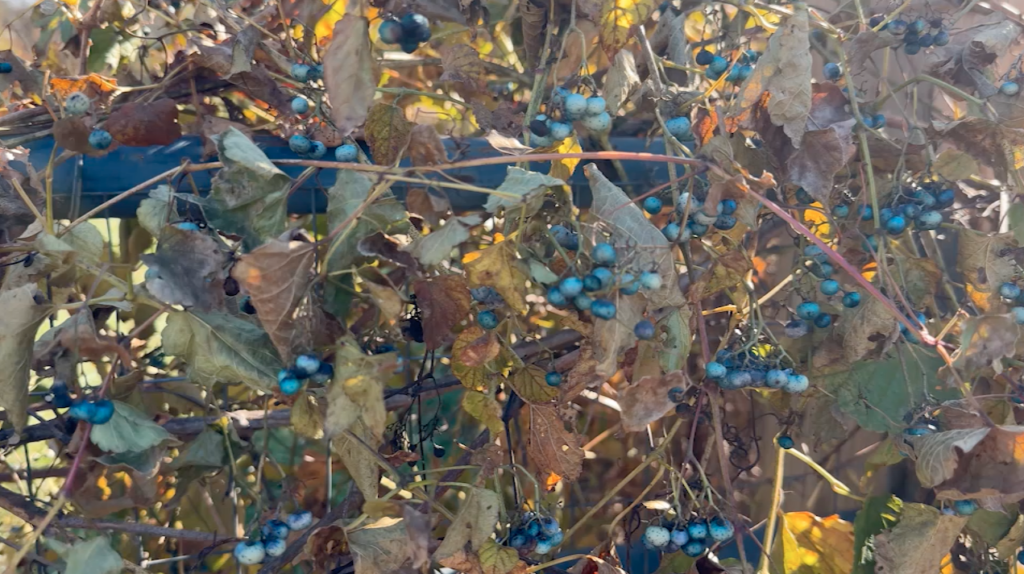
– Porcelain Berry, edible and good for making baskets.
– Bayberry, used for making candles.
Plants can be used in teas, tinctures, balms and more. Acorns can be foraged as well.
“The natives would have ground that into flour and made like pancakes with it,” Amanda shared. “If you’re going to collect acorns, float them in water and of the ones that float scoop them out and the ones that sink, you can utilize for different recipes, and you can eat them as they are. I know people will boil them to get the tannins out.”
When foraging, there are a few things to keep note of. Amanda suggested only take a third of what you see, as well as slicing only half of the root of a plant, so that gives the plant time to grow back.
“Always be careful with ingesting anything. Always consult your doctor,” Amanda cautioned. “Medicinal plants can also interact with pharmaceuticals. That’s always something to consider and do some of your own research on. There’s lots of great books out there.”
Edible plants can also have lookalikes that are not edible. To learn more, visit Meadowlands Retreat.